The IPL Reshaped Commercial Entertainment Through Calculated Expansion
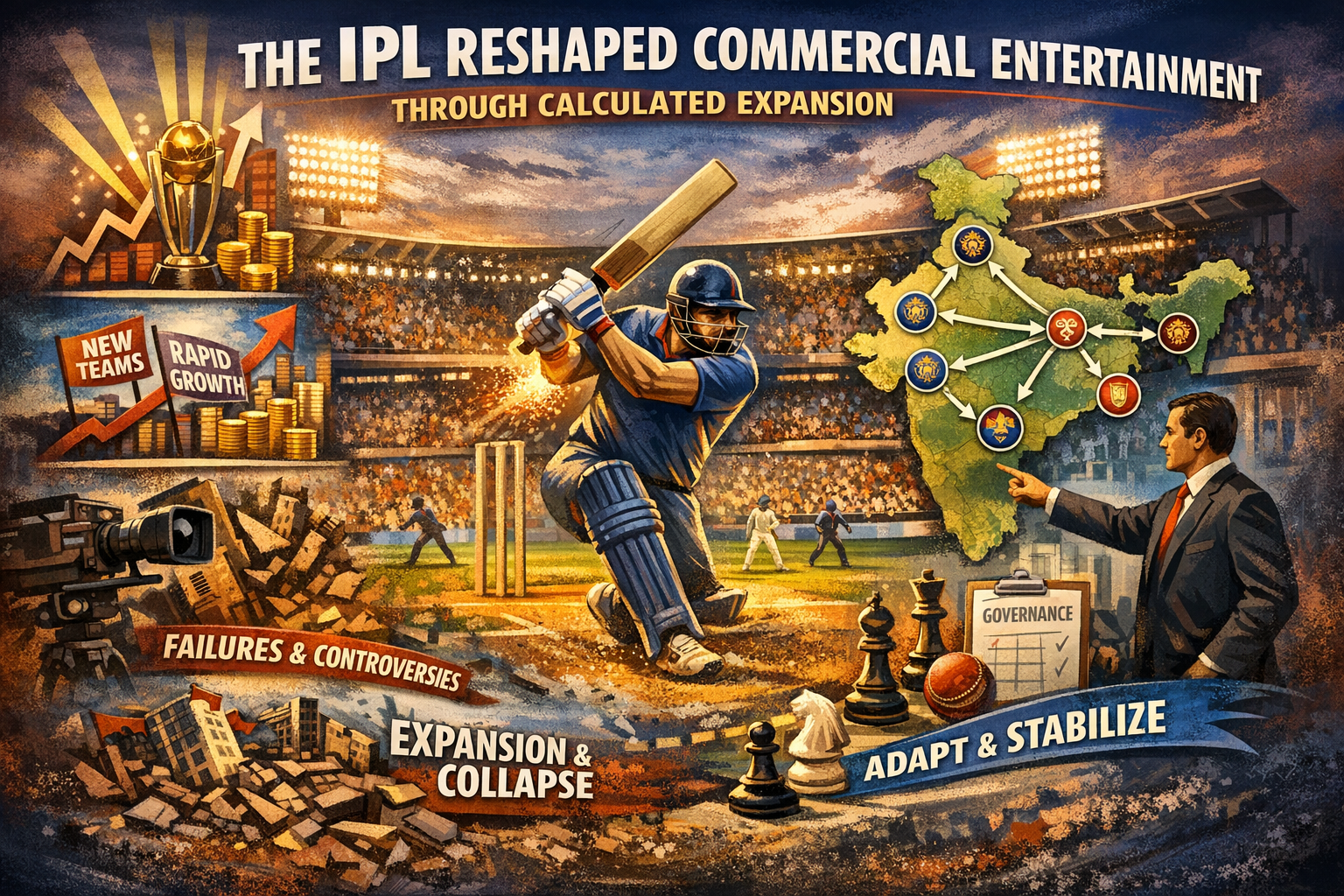
When the Indian Premier League launched in 2008 with eight franchises, it was not merely a new format for cricket — it was a commercial experiment testing whether an entire entertainment economy could be built around a six-week annual event. Sixteen years on, that experiment has produced one of the most valuable and studied franchise-based entertainment properties in the world, shaped as much by its failures as its successes. The story of how the IPL grew, contracted, and restructured tells us something important about the fragile economics of rapid institutional expansion.
The First Wave of Growth and Why It Stumbled
The IPL's initial structure — eight franchises, a short calendar window, a clearly defined format — created the conditions for intense commercial interest. The compactness was a feature, not a limitation. Every fixture carried weight. Broadcasters, advertisers, and investors responded accordingly, and by 2011 the governing body moved to capitalise on that momentum by adding two new franchises: the Pune Warriors India and the Kochi Tuskers Kerala.
The expansion looked logical on paper. India's geographic diversity offered untapped markets, and investor appetite was demonstrably high. But the move exposed a gap between commercial enthusiasm and institutional readiness. The Kochi franchise survived a single season before being terminated. Pune lasted a few years before financial disputes ended its participation. Around the same period, the Deccan Chargers franchise was also terminated — in 2012 — and replaced the following year by the Sunrisers Hyderabad. Three franchise failures in a short window revealed that signing investors and sustaining franchise operations over multiple years are fundamentally different challenges.
The core issue was structural. Franchise models require long-term financial commitment, regulatory clarity, and robust governance frameworks. In the IPL's early expansion phase, those foundations were not uniformly in place. The result was instability that threatened to undermine the credibility the property had spent its first years building.
Suspension, Substitution, and Institutional Flexibility
The period from 2016 to 2017 introduced a different kind of disruption. Two of the IPL's most commercially significant and historically rooted franchises — the Chennai Super Kings and the Rajasthan Royals — were suspended following governance and conduct-related findings. Their absence created an immediate structural problem: a reduced number of franchises would have altered the format, affected broadcast commitments, and signalled fragility to commercial partners.
The response was pragmatic. Two temporary franchises, the Gujarat Lions and the Rising Pune Supergiant, were introduced specifically to fill the gap for the duration of the suspensions. This was not expansion in any growth-oriented sense. It was a form of institutional substitution — maintaining the operational architecture while the underlying problem was addressed. The two temporary franchises were discontinued once Chennai and Rajasthan returned.
What this episode demonstrated was that the IPL had developed sufficient institutional maturity to manage a significant disruption without public collapse. Contingency planning of that kind does not emerge from enthusiasm alone. It reflects accumulated governance experience — however imperfect — and a recognition that the property's value depends on structural consistency.
The 2022 Expansion: A More Durable Architecture
The addition of two new franchises in 2022 — the Gujarat Titans and the Lucknow Super Giants — returned the number of active franchises to ten. On the surface, this echoed the 2011 expansion. In practice, the conditions were substantially different.
The 2022 auction process for the new franchises was conducted with significantly higher valuations than earlier rounds, reflecting both the property's demonstrated commercial durability and a more competitive investor environment. The franchises entered a more established ecosystem: broadcast infrastructure, player auction systems, and operational norms had been refined over more than a decade. Both new franchises moved into competitive positions quickly, with the Gujarat Titans winning the competition in their inaugural year — an outcome that underscored the format's structural balance.
The contrast with 2011 is instructive. Early expansion tested whether the IPL's model was scalable. The 2022 expansion suggested the answer was yes — provided the governance structures, financial thresholds, and institutional oversight were sufficiently developed before the franchises were admitted.
Beyond Franchises: A Global Commercial Footprint
The IPL's evolution has not been limited to adding or removing franchises within India. Several franchise ownership groups have invested in cricket competitions in other countries, extending their brand presence into Caribbean, South African, UAE, and other emerging franchise-cricket markets. This internationalisation of franchise ownership reflects a broader shift: the IPL has become a model for how franchise-based entertainment properties can be exported, adapted, and monetised across different cultural and regulatory environments.
Media rights valuations for the IPL have grown substantially with each successive cycle, and the property's international broadcast reach has expanded in tandem. What began as a domestic entertainment product is now consumed across multiple continents, with rights deals structured to reflect that global audience. The commercial logic driving these numbers is straightforward — consistent format, concentrated calendar, high-profile participants, and a vast domestic base that travels well across diaspora communities worldwide.
The IPL's institutional history is, in the end, a case study in the difficulty of scaling entertainment economies too quickly, and the slower, more durable rewards of getting the architecture right before growth is pursued. Its failures were instructive. Its recoveries were deliberate. The result is a property whose current scale was earned through a considerably more turbulent journey than its present dominance suggests.